


Finding a veterinarian used to be pretty simple.
Ask a friend. Check the phone book. Drive past a clinic enough times that you remember the name.
Today?
Pet owners have a LOT more options.
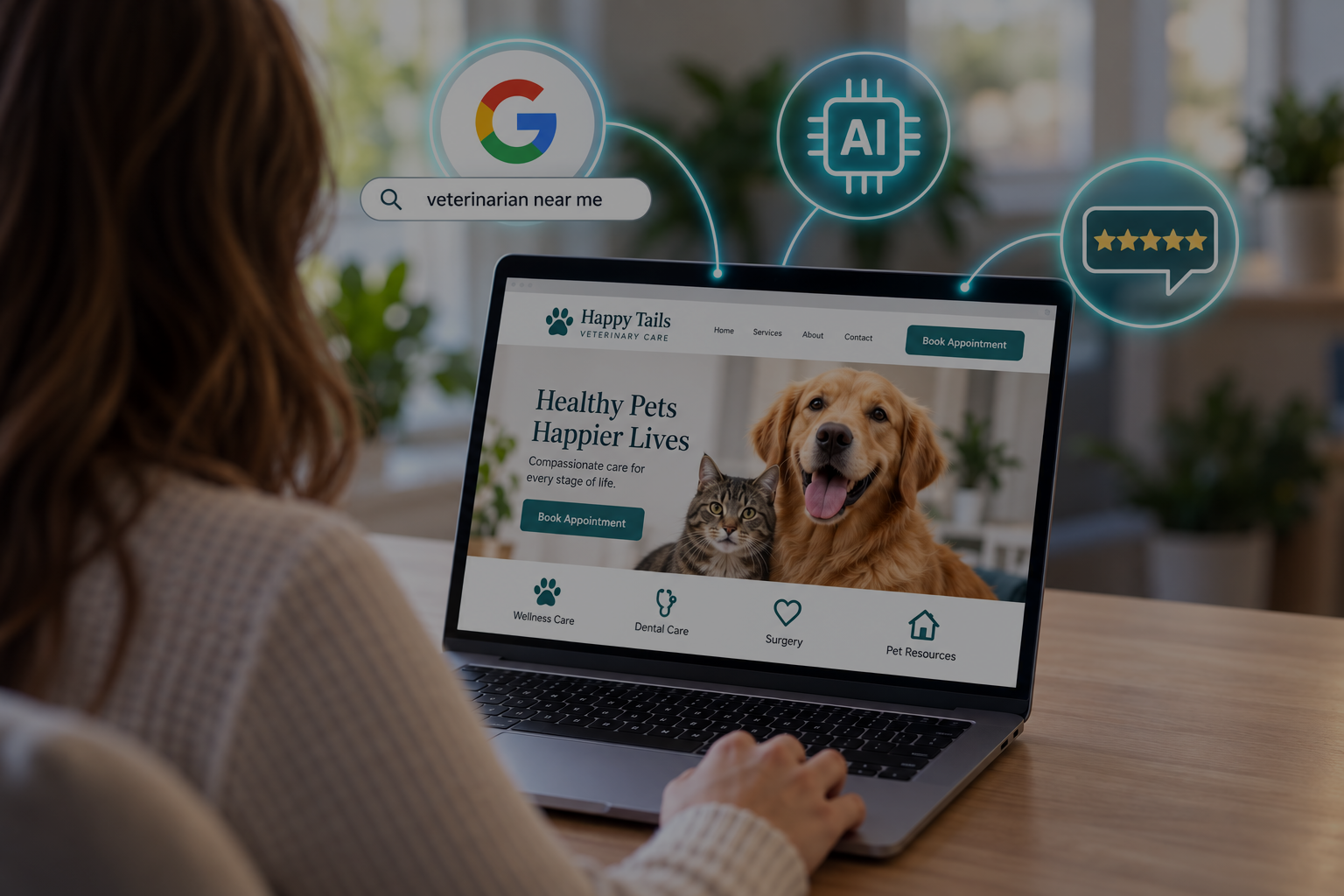
They search Google. They read reviews. They look at your website. They check your Facebook or Instagram. They ask neighbors in local groups.
And increasingly, they can ask AI.
Someone looking for a veterinarian today might type:
“Veterinarian near me.”
Or they might ask:
“Find a highly rated veterinarian near me that offers same-day appointments and is good with anxious dogs.”
Those are two very different searches.
For veterinary practices, that means simply having a website and a Google listing isn’t enough anymore.
You need to be easy to find—and easy to choose.
1. Google Is Still a REALLY Big Deal
Let’s not bury Google just yet.
When someone needs a veterinarian—especially when they’ve just moved, adopted a new pet or have a sick animal—Google is often one of the first places they turn.
And many of those searches have local intent:
“Veterinarian near me”
“Emergency vet near me”
“Dog dentist in [city]”
“Cat veterinarian near me”
“Veterinarian open Saturday”
That’s why your local search presence matters so much.
Your Google Business Profile should be accurate and complete. Your website should clearly explain your services and location. And individual services should have enough information for Google to understand what your practice actually offers.
If you perform veterinary dentistry, for example, don’t make Google figure that out from one sentence buried on your homepage.
Make it obvious.
The easier it is for search engines to understand your practice, the better chance you have of appearing for searches that matter.
2. Reviews Can Be the Difference Between Getting Seen and Getting Chosen
Imagine you’re looking at two veterinary practices.
One has:
4.8 stars and hundreds of reviews.
The other has:
4.2 stars and 31 reviews.
Which one are you clicking first?
Exactly.
Reviews provide something your own marketing can’t:
Other people saying you’re great.
And pet owners don’t necessarily stop at the star rating.
They’re reading what people say about your doctors. They’re looking for comments about how the team treated someone’s nervous dog. They’re checking whether appointments felt rushed. They’re reading about communication, compassion and overall experience.
They’re also looking at how your practice responds to reviews.
A thoughtful response to a negative review can sometimes tell a prospective client just as much about your practice as a glowing five-star review.
Your reputation is part of your marketing whether you’re actively managing it or not.
3. Your Website Has to Confirm Their Decision
Congratulations!
They found you on Google. They liked your reviews. They clicked your website.
Now don’t lose them.
Your website should immediately answer some very basic questions:
Am I in the right place?
Do they offer what I need?
Do I trust these people with my pet?
How do I make an appointment?
This is why good veterinary website design matters.
Your website doesn’t need twelve animations and a cinematic intro sequence.
It needs to make people feel confident about choosing you.
Show your actual doctors. Show your team. Show your hospital. Explain your services. Make your phone number easy to find. Make scheduling an appointment simple.
And please, please make it work well on a phone.
That’s probably where your prospective client is looking at it.
4. Social Media Helps Pet Owners Get to Know You
Social media doesn’t always get the credit it deserves in the decision-making process.
Someone might discover you through Google and then jump over to Facebook or Instagram before making an appointment.
What are they going to find?
If your last post says “Happy Thanksgiving!” and it’s currently July…
Not ideal.
Your social media gives people another opportunity to see the humans behind the hospital.
Introduce your doctors. Celebrate your team. Share patient photos. Show what happens behind the scenes. Answer common pet health questions.
Be a little goofy sometimes.
Veterinary medicine is incredibly personal. People are trusting you with an animal they consider part of their family.
Showing the people behind the practice helps build familiarity before that first appointment ever happens.
5. Now Pet Owners Can Ask AI
This is the part that’s changing quickly.
Instead of searching Google and reviewing a page full of results, people can now ask tools like ChatGPT and Gemini much more detailed questions.
For example:
“What’s a highly rated veterinarian near me that offers dental care and has Saturday appointments?”
The AI may respond with a much smaller group of recommendations.
That’s a pretty significant change.
It means businesses need to think beyond:
“How do I rank for this keyword?”
And start thinking about:
“Does the internet clearly understand who we are and what we do?”
There isn’t a secret code we can put on your website that guarantees ChatGPT will recommend your practice.
If we find one, we’ll let you know.
Until then, the goal is to strengthen the information and authority surrounding your practice online.
Your website. Your service pages. Your location information. Your Google Business Profile. Reviews. Content. Structured data. Mentions of your practice across reputable websites.
All of these help create a clearer picture of your business online.
That’s why modern veterinary SEO and AI search optimization need to work together.
Search is no longer happening in just one place.
6. Getting Found Is Only Half the Battle
This is the part that’s easy to forget.
You can rank #1. You can have hundreds of reviews. You can show up in an AI recommendation. You can have a beautiful website. But the pet owner still has to choose you.
That’s why all of these pieces work better together.
Someone discovers your practice. They recognize your name from social media. They read your reviews. They visit your website. They see your doctors and your team. They realize you offer exactly the service they’re looking for. Then they call.
That’s not one marketing tactic doing all the work. That’s your entire digital presence working together.
Make Your Practice Easy to Find—and Easy to Choose
The way people search for businesses will continue to change.
Google will change.
AI will change.
Social media will definitely change.
Probably five minutes after we publish this.
But one thing isn’t changing:
Pet owners want to find a veterinarian they can trust.
Your marketing should make that decision easier.
Walker Kreative helps veterinary practices build a stronger digital presence through websites, SEO, AI search optimization, social media, video, advertising and overall veterinary marketing.
Because getting found is step one.
Getting chosen is what actually matters.